How to Detect Alt Accounts and Bots in a Discord Giveaway
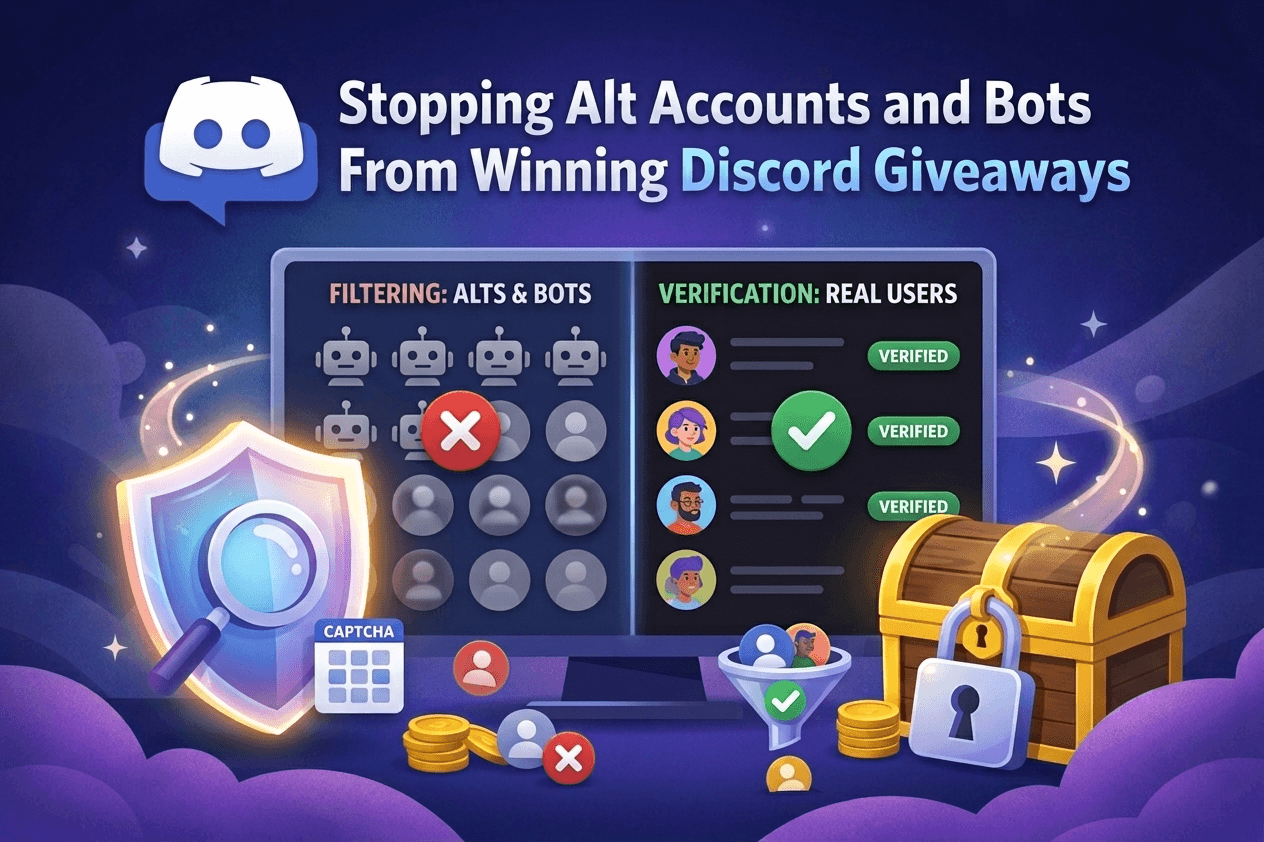
To detect alt accounts and bots in your giveaways, use a Discord giveaway bot with built-in fraud detection like ScopliDrop. It analyzes every entry in real time, groups suspicious accounts into fraud rings, and excludes them from winner selection. No manual review or captchas required.
What Is an Alt Account in a Discord Giveaway?
An alt account in a Discord giveaway is a secondary Discord account used by the same person to enter the same giveaway more than once. Alt accounts let one participant unfairly stack their odds, pushing out legitimate entrants. They are the most common form of Discord giveaway fraud, alongside automated bots.
The Real Problem With Discord Giveaways
Every Discord giveaway has the same silent tax. A chunk of the entries aren't real. Some are automated bots clicking through the flow. Some are alt accounts from the same person trying to stack the odds. Some are just friends of friends quietly entering twice from a second account they forgot they had.
It doesn't take much. A few extra entries from the wrong place and a legit participant loses a prize they actually earned. Multiply that across hundreds of giveaways a week and trust quietly erodes. People stop entering. Hosts stop caring about winners. The whole thing becomes theater.
ScopliDrop is a Discord giveaway bot with built-in anti-fraud detection. The goal is to block fake entries before they ever reach a winner roll, without making real participants jump through hoops to enter. The product side, what gets flagged, what the draw excludes, and what you control, lives on the alt account and bot detection feature page. Here's how we think about it.
What Cheating Actually Looks Like
Most cheating in Discord giveaways falls into three buckets. Knowing them helps you understand what any fraud detection system is really fighting.
| Cheater type | What it looks like | Why they do it |
|---|---|---|
| Automation operators | Scripted entries from headless browsers or automation tools, often hundreds at a time | Grinding prizes at scale, reselling, flipping keys |
| Alt farmers | One person running multiple Discord accounts through the same entry flow | Stacking personal odds on a giveaway they really want to win |
| Casual alt users | Two or three accounts from the same household or same person, often half-intentional | Small edge, low effort, rarely organized |
The first group is loud and technical. The second is the biggest real-world problem. The third is the hardest to judge because it overlaps with legit shared households: siblings on the same Wi-Fi, roommates, parents and kids. A good fraud detection system has to catch the first two without burning the third.
That tension is the whole game.
How ScopliDrop Protects Your Giveaways
We're not going to publish the exact signals we check or the thresholds behind them. That would just become a bypass checklist for cheaters, and the whole point of fraud detection is that attackers don't know which door they're walking into.
What we can say is that protection runs in layered categories, and every entry gets evaluated across all of them before it's ever eligible to win.
Fraud detection doesn't block entries at the door. It evaluates them, flags the suspicious ones, and either excludes them from winner selection automatically or surfaces them for the host to review. Real participants always get through the flow. They just get through cleanly.
Automation detection
Bots behave differently than humans, even when they're trying hard not to. Headless browsers, automation frameworks, and scripted clickers leave traces that genuine users never produce. We analyze those traces on every entry. Most automated entries get caught before they're even compared against other participants, which keeps the rest of the system focused on the harder problem: actual humans using alts.
Device-level signals
A single person using multiple Discord accounts still typically uses the same device. Modern browsers expose enough information to build a stable device fingerprint without ever touching cookies, localStorage, or anything a privacy mode would clear. We combine those signals into a fingerprint that's reliable enough to catch alt farmers and forgiving enough to avoid collisions between strangers who happen to own similar hardware.
This is the single most important category for catching alt accounts, because the cheater's own convenience works against them. They almost never switch devices between alts.
Network signals
IPs alone are a terrible fraud signal. Families share them, mobile carriers rotate them behind carrier-grade NAT, and public Wi-Fi puts hundreds of strangers behind the same address. But IPs combined with other signals become useful. A single device under one IP is normal. Several unrelated devices under one IP is normal. The same device appearing on the same giveaway multiple times is not.
We treat network data as supporting evidence, never as the main accusation.
Behavioral signals
Beyond the device itself, the way an entry flows through the page carries information. We use that carefully and only in contexts where it's actually meaningful. On single-click flows where there's barely any interaction to measure, we skip behavioral analysis entirely rather than invent signal where there is none. False positives on legit users are worse than missed catches on cheaters.
Suspicious vs Excluded Entries
Every entry that gets flagged lands in one of two states, and understanding the difference matters if you host giveaways.
Yellow flag — suspicious. The entry has enough signal to be worth looking at, but not enough to call it fraud with confidence. These entries stay eligible for the winner roll. They're surfaced in your dashboard so you can review them if a giveaway feels off, but we don't remove them automatically. This is the "siblings on the same Wi-Fi" zone, and we'd rather let a borderline legit entry win than punish a real participant because their household looked weird on paper.
Red flag — excluded. The entry has high-confidence fraud signal. These are automatically removed from winner selection. They still show up in your dashboard for transparency, but they can't win. This is where clear-cut automation, obvious device duplicates, and organized alt farming land.
The split exists because fraud detection isn't a binary. Real cheating sits on a confidence spectrum, and treating every suspicious entry the same way guarantees false positives. Two tiers let us be aggressive where we're sure and cautious where we're not.
Plan note. Flagged entries and winner exclusion are available on Premium and Business plans. Free giveaways still run cleanly, but the flagging layer is a paid feature.
Catching Fraud Rings After The Fact
Here's the part most fraud detection systems get wrong. They evaluate each entry at the moment it comes in and then forget about it.
The problem is that fraud is often only visible in retrospect. The first alt account from a cheater might look perfectly clean because there's nothing to compare it to yet. It's only when the second, third, and fourth alts come in that the pattern becomes obvious. If the first entry already sits in the pool unflagged, a naive system will happily let it win.
ScopliDrop handles this with retroactive flagging. When a new entry gets caught, the system looks back at every prior entry it's linked to and re-evaluates them. If the link is strong enough, those earlier entries get flagged too, even though they looked clean when they came in. That means a fraud ring discovered on entry number five cleans up entries one through four automatically, without any host intervention.
The end result is that the longer a giveaway runs, the more accurate the flagging gets. Time works in the host's favor, not the cheater's.
How to Check a Fraud Ring in Your Dashboard
When an entry gets flagged, you don't have to take the system's word for it. Every flagged entry in your giveaway dashboard is clickable, and clicking the flag opens the full fraud ring behind it: every related account the system linked together, and the reason each link was made.
Example of a Discord giveaway fraud ring in the ScopliDrop dashboard showing linked alt accounts
Here's the flow:
- 1
Open the giveaway details page
From your dashboard, open the giveaway you want to audit. You'll see all entries listed, with flagged ones clearly marked.
- 2
Find a suspicious participant
Look for entries with a yellow or red flag icon next to them. These are the ones the system wants you to look at.
- 3
Click the flag
Clicking the flag opens the full fraud ring. You'll see every account linked to that entry, along with the reason each connection was made.
- 4
Decide what to do
Red rings are excluded from the roll, yellow rings stay eligible. If you disagree with a flag, you can unflag the entry manually.
Fraud rings are a Business-plan feature. Basic flagging and winner exclusion work on Premium and Business, but the drill-down view that shows the full ring and the reasons behind each link is reserved for Business.
What you'll see, and what you won't
We take participant data seriously. When you open a fraud ring, ScopliDrop will never expose raw technical fingerprints, IP addresses, device IDs, or any low-level identifier tied to a participant. What you see is intentionally limited to:
- The high-level links between accounts (which entries the system grouped together)
- The detection reason for each link (for example, "shared device" or "shared network indicators")
- Standard participant info you already have access to as a host
That's it. The underlying signals that power the detection stay on our side, protected. This keeps hosts informed enough to make good decisions without turning a giveaway dashboard into a surveillance tool. For the full picture on how we handle participant data, see our privacy policy.
What This Means For Hosts And Participants
For hosts, the practical impact is that winner rolls just work. You don't need to audit each entry by hand. You don't need to run your own anti-cheat. The entries that show up in the dashboard are already filtered, scored, and sorted, and the ones excluded from winning are clearly marked so you know why. If a giveaway feels off, the flagged list tells you the story.
For participants, the impact is quieter but more important. You're not competing against hundreds of invisible bots. You're not losing prizes to someone running ten alts on the same laptop. The pool you're entering is closer to the pool you see, and that's the whole promise of a fair giveaway.
Neither side has to think about the system for it to do its job. That's the point.
FAQ
Run Giveaways Your Community Can Actually Trust
Fraud detection isn't a feature you should have to think about. It should just be there, quietly doing its job while you focus on running a good giveaway. That's what we've built, and that's what every giveaway on ScopliDrop gets by default.
If you're tired of wondering whether your winners are real, try ScopliDrop for your next giveaway. It takes a few minutes to set up and the fraud detection runs automatically from entry one.